

The
videogame
industry
is
in
a
dangerous
space
at
the
moment
as
it
goes
through
a
hellish
self
correction
resulting
in
numerous
studios
shutting
down
and
people
losing
their
jobs.
In
many
ways,
it
appears
to
have
grown
too
big,
too
quickly,
and
one
of
the
ways
we
can
see
that
is
through
the
sheer
amount
of
games
competing
for
people’s
attention.
One
of
the
easiest
places
to
see
this
is
Steam.
As
the
biggest
PC
storefront
around,
it
has
a
staggering
amount
of
games
being
released
on
a
daily
basis,
and
according
to
Steam
tracking
site
SteamDB,
2024
saw
the
biggest
increase
since
2017.
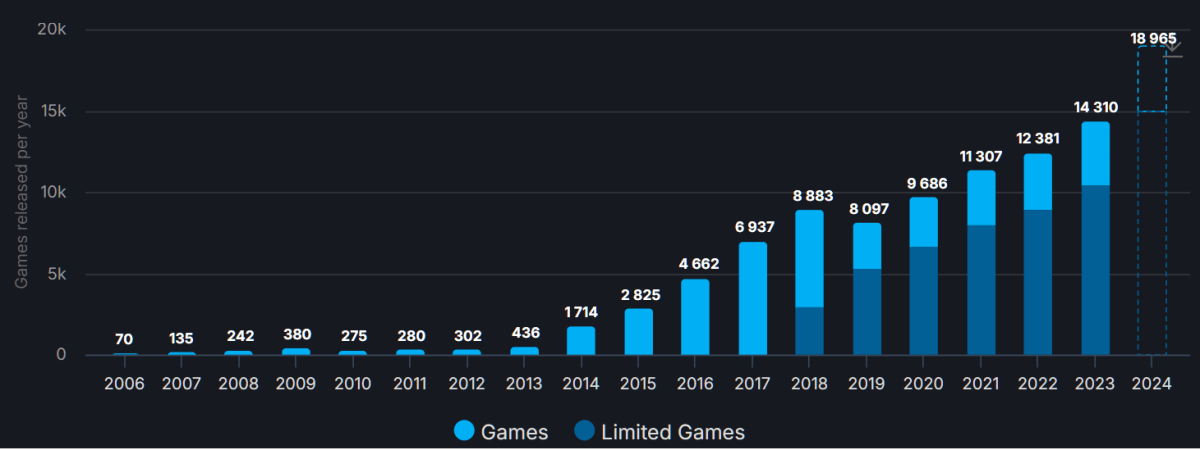
According
to
the
data,
just
under
20,000
games
were
put
on
Steam
last
year,
versus
the
14,310
that
were
released
in
2023.
That’s
a
rise
of
32.52%.
Now,
in
fairness
this
isn’t
the
biggest
increase
Steam
has
ever
seen.
For
example,
in
2014
the
platform
saw
a
huge
upswing
in
games
being
released
onto
the
platform,
jumping
up
from
the
fairly
consistent
400
or
so
per
year
to
1,714.
That’s
a
293.1%
increase.
Why,
you
ask?
Simple:
Valve
became
lessy
picky
about
what
could
be
released
on
their
storefront,
and
the
rest
is
history.
Since
2014,
the
store
has
seen
more
and
more
games,
as
you
can
see
from
this
chart
below.
| Year | Games |
% Increase |
| 2014 | 1,714 | 293.1% |
| 2015 | 2,825 | 64.82% |
| 2016 | 4,662 | 65.03% |
| 2017 | 6,937 | 48.8% |
| 2018 | 8,883 | 28.05% |
| 2019 | 8,097 | -8.84% |
| 2020 | 9,686 | 19.62% |
| 2021 | 11,307 | 16.73% |
| 2022 | 12,381 | 9.49% |
| 2023 | 14,310 | 15.58% |
| 2024 | 18,965 | 39.52% |
Advertisements
Based
on
the
numbers,
this
year
has
seen
an
average
of
51.95
games
release
PER
DAY
on
Steam.
Unsurprisingly,
many
of
these
games
are
getting
lost
in
the
shuffle,
unable
to
standout
amongst
the
hundreds
of
releases
hitting
the
storefront
every
week.
As
for
Steam,
it’s
still
doing
great.
VGInsights
claims
that
the
platform
brought
in
$11bn
in
revenue
in
2024,
up
from
2023’s
£8.8bn
and
2022’s
$7.6bn.
The
number
of
people
using
the
platform
keeps
rising,
too.
On
December
15th,
39,319,632
people
were
logged
onto
Steam
at
the
same
time,
breaking
the
previous
record
of
33.59
million
achieved
in
2023.
It
seems
a
safe
bet
that
Steam
will
blast
through
40+
million
concurrent
users
in
2025.
So
in
other
words,
while
there
are
more
games
than
ever
being
put
onto
Steam,
there
are
also
more
players
than
ever,
too.
But,
to
my
feeble
mind,
it
still
raises
the
important
question
of
just
how
sustainable
this
all
is.
2024
saw
some
pretty
big
names
struggling
to
reach
their
sales
goals.
Steam’s
own
data
showed
that
its
users
only
spent
15%
of
their
time
playing
titles
released
in
2024.
47%
played
titles
ranging
from
1-7
years
old.
Likewise
on
console,
the
top
played
games
are
frequently
dominated
by
older
games
like
Mincraft
and
free-to-play
titles
such
as
Fortnite.
Speaking
of
the
fight
for
attention,
let’s
talk
about
limited
games.
SteamDB
divides
all
of
its
tracked
games
into
two
categories:
games
and
“limited
games.”
Limited
games
are
those
that
have
not
achieved
the
required
player
engagement
or
sales
numbers
to
get
rid
of
the
“Profiled
Feature
Limited”
tag
that
Steam
gives
them.
This
tag
stops
them
from
appearing
on
people’s
achievements
list,
for
example,
or
being
used
to
craft
medals.
The
idea
being
that
it
helps
stop
abuse
of
the
trading
card
system,
achievements
and
more.
It’s
worth
remembering
that
games
that
fall
under
the
“Limited”
category
are
not
always
shovelware
or
junk.
It
just
might
be
a
small
release
that
never
found
a
big
audience,
a
passion
project
someone
released
for
free
or
something
else
entirely.
Of
the
18.9k
games
released
onto
Steam
in
2024,
14.9k
of
them
fell
into
the
“Limited
Games”
category.
If
we
take
“Limited
Games”
out
of
the
equation
for
a
moment
and
focus
solely
on
titles
that
got
enabled
profile
features,
the
numbers
aren’t
quite
as
scary:
3,
984.
Compared
to
the
3,878
of
last
year,
that’s
a
very
small
increase.
The
year
before
(2022)
that
it
was
3,495.
Looking
at
that
data,
we
can
postulate
that
while
the
total
number
of
games
being
released
is
increasing
exponentially,
the
amount
of
them
that
are
actually
finding
an
audience
is
growing
at
a
far
slower
rate.
In
other
words,
there
are
a
lot
of
games
hitting
Steam
that
get
buried
under
the
software
landslide.
The
likes
of
PlayStation,
Xbox
and
Switch
are
facing
similar
problems.
On
the
PlayStation
store,
for
example,
there
are
190
releases
listed
since
the
5th
of
December.
While
that’s
not
as
crazy
as
Steam,
it’s
still
a
lot
of
games
for
people
to
sift
through.
No
wonder
an
indie
game
being
released
onto
such
a
busy
market
finds
it
hard
to
get
noticed.
What
do
you
make
of
this
data?